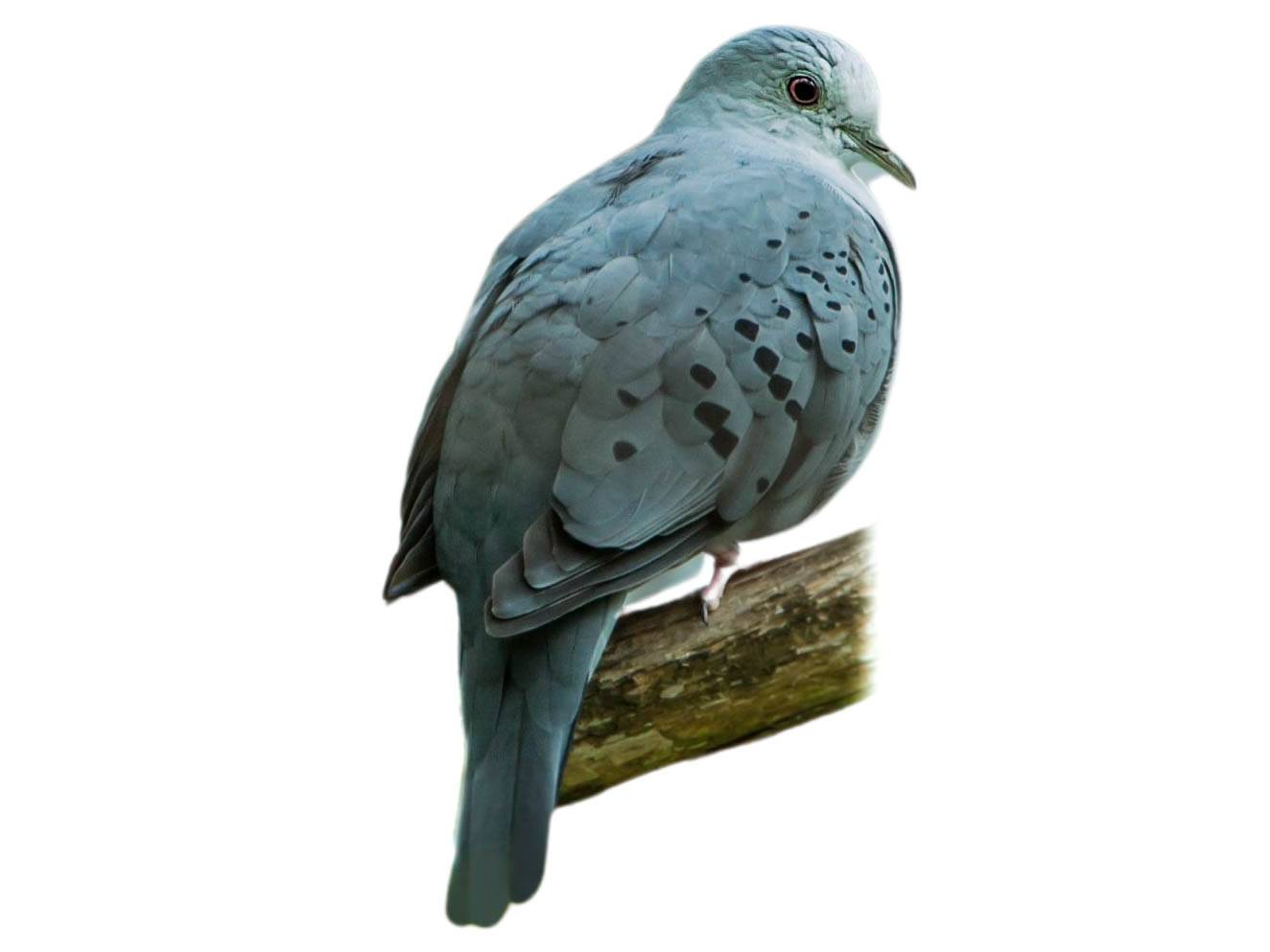
Blue Ground Dove
Claravis pretiosa
The blue ground dove, Claravis pretiosa, is a diminutive New World tropical dove, exhibiting a charming dichotomy in plumage between the sexes. The males are adorned with blue-grey upperparts and a paler grey below, with a striking grey-white face. Their wings are punctuated with conspicuous black spots, and their flight feathers and outer tail feathers are tinged with blackish hues. The females, on the other hand, display a grey-brown head, neck, and breast, with the underwings and belly a soft blue-grey. Their back is a warm ruddy brown, which contrasts beautifully with the chestnut rump and tail. Both sexes share the characteristic red or yellow iris, a green bare eyering, and flesh-pink legs.
Identification Tips
Adult males are distinguished by their blue-grey plumage and black-spotted wings, while females are recognized by their grey-brown and ruddy brown coloration with chestnut wing spots. The male's red or yellow iris and green eyering are notable features. In regions where they coexist with similar species, the blue ground dove can be identified by its size and specific color patterns.
Habitat
The blue ground dove favors open woodland, forest edges, and clearings, thriving particularly in humid areas. It is typically found from sea level up to an elevation of approximately 1200 meters.
Distribution
This species is a resident breeder with a range extending from southeastern Mexico through to northwestern Peru and northern Argentina, and is also found on the island of Trinidad in the Caribbean.
Behaviour
These doves are often seen alone, in pairs, or in small groups. They are ground feeders, foraging for seeds and small insects, and are known to ingest grit. The male's song is a distinctive loud "boop," usually delivered from the treetops.
Song & Calls
The male blue ground dove is known for its sonorous "boop" call, which resonates from the treetops and serves as a vocal beacon within its habitat.
Breeding
The blue ground dove constructs a rather insubstantial twig nest, typically situated 1 to 11 meters above the ground in a tree. The female lays a clutch of two white eggs.
Similar Species
In its range, the male blue ground dove may be confused with species of the genus Paraclaravis. Females may resemble those of Paraclaravis but are more commonly mistaken for the smaller female ruddy ground dove, which has blackish wing markings instead of chestnut-brown.
Diet and Feeding
The diet of the blue ground dove consists mainly of seeds and small insects. They exhibit a preference for feeding on the ground and are known to consume grit to aid in digestion.
Conservation status
The blue ground dove is currently classified as Least Concern on the IUCN Red List, indicating that it is not at immediate risk of widespread decline.






Blue Ground Doves on Birda
Photos


Sightings


More Pigeons, Doves



Your birdwatching journey like never before
Connect with nature in minutes

Discover the joy of birding

Play your part in saving nature
Birda Blog


What Our Birders Say

Great bird recording
Fantastic to be involved
Gets me outdoors more
Makes you want to spot birds more
Work together with community
A Friendly Place
Great app for learning Birds
Fantastic app - Love it!
Loving it
Simply fantastic