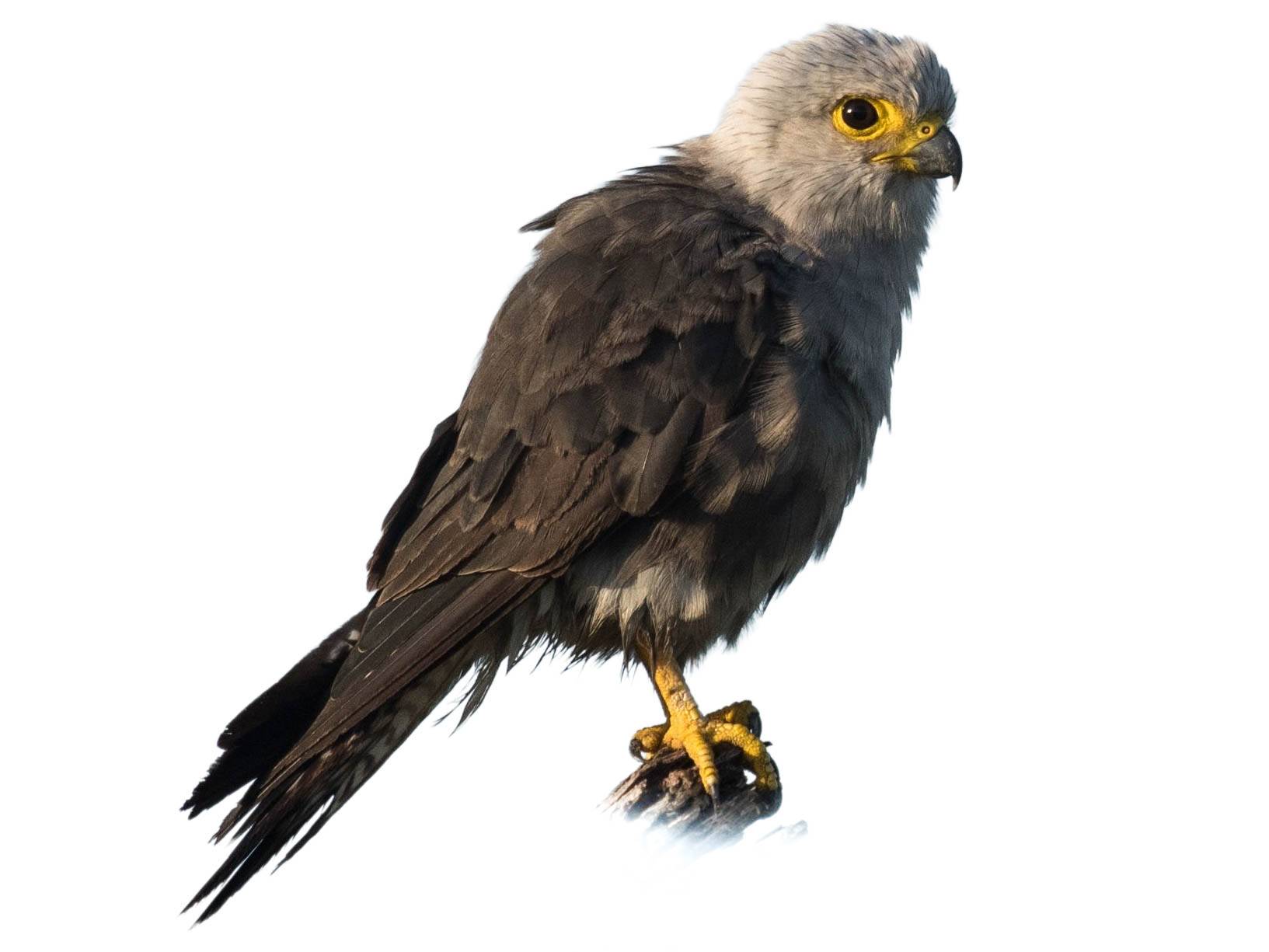
Dickinson's Kestrel
Falco dickinsoni
The Dickinson's kestrel, or Falco dickinsoni, is a bird of prey from the falcon family Falconidae, named in honor of John Dickinson, an English physician and missionary. This species, also known as the white-rumped kestrel, is a relatively small and robust kestrel with a distinctive large, square head. Adults measure between 27 to 30 centimeters in length, with a wingspan of 61 to 68 centimeters, and weigh from 167 to 246 grams. The females are marginally larger and heavier than the males. Their plumage is predominantly dark grey, with a paler head and rump. The tail features grey with narrow black bars and a broad subterminal band, while the underside of the flight feathers are barred. The cere and feet are a striking yellow, with bare yellow skin encircling the eye. The bill is dark grey, and the eyes are a deep brown. Juvenile birds present a grey-brown coloration with barred flanks, lacking the paler head and rump of adults, and have a greenish cere and eye-ring.
Identification Tips
When identifying Dickinson's kestrel, look for the pale head and rump contrasting with the darker grey body. The yellow cere and feet, as well as the yellow skin around the eye, are key features. In flight, observe the barred underside of the wings and the broad subterminal band on the tail.
Habitat
This kestrel favors savanna and open woodland habitats, particularly those that are swampy and near water. It has a strong association with miombo woodland and is often seen around palm trees, such as Hyphaene and Borassus species, as well as baobab trees. It can also be found in coconut plantations in certain regions.
Distribution
The Dickinson's kestrel's range extends across much of Mozambique, Zimbabwe, Zambia, and Malawi, with its presence also noted in northeastern South Africa, northern Botswana, northeast Namibia, eastern Angola, southern Democratic Republic of the Congo, and parts of Tanzania. It is an occasional visitor to Kenya, with a total range of about 3.4 million square kilometers.
Behaviour
This kestrel typically hunts from a perch rather than by hovering. It preys on large insects like grasshoppers, as well as lizards, amphibians, and occasionally birds, bats, rodents, and snakes. It is known to be attracted to grass fires, seizing the opportunity to capture insects and other prey in flight.
Song & Calls
The Dickinson's kestrel is usually silent but emits a high-pitched alarm and contact call. At the nest, a soft, mewing call is used to attract the young for feeding.
Breeding
The breeding season varies by region, occurring from July to October in Tanzania and from September to December further south. The nest is a simple scrape, often located in the crown of a dead palm or in a baobab hole, and sometimes in an old Hamerkop nest. It is placed 2 to 18 meters above the ground. The female lays one to four cream-colored eggs with reddish-brown markings and incubates them for at least 30 days. The fledging period for the young is approximately 33 to 35 days.
Similar Species
Dickinson's kestrel is closely related to the grey kestrel and banded kestrel, and they are sometimes grouped in the subgenus Dissodectes. However, the Dickinson's kestrel can be distinguished by its unique plumage and habitat preferences.
Diet and Feeding
The diet of Dickinson's kestrel is predominantly composed of large insects, with grasshoppers being a staple. It also consumes a variety of other prey including lizards, amphibians, and occasionally birds, bats, rodents, and snakes.
Conservation status
The IUCN Red List has classified Dickinson's kestrel as Least Concern. However, the loss of palm trees, which are an important part of its habitat, poses a potential threat to the species.






Dickinson's Kestrels on Birda


Sightings


More Caracaras, Falcons



Your birdwatching journey like never before

Connect with nature in minutes

Discover the joy of birding

Play your part in saving nature
Birda Blog


What Our Birders Say

Fantastic to be involved
Work together with community
Fantastic App
A mordern game changer
Loving it
Terrific App for Birders
Awesome App
Birda fan
Just what birding needs
Wonderful App