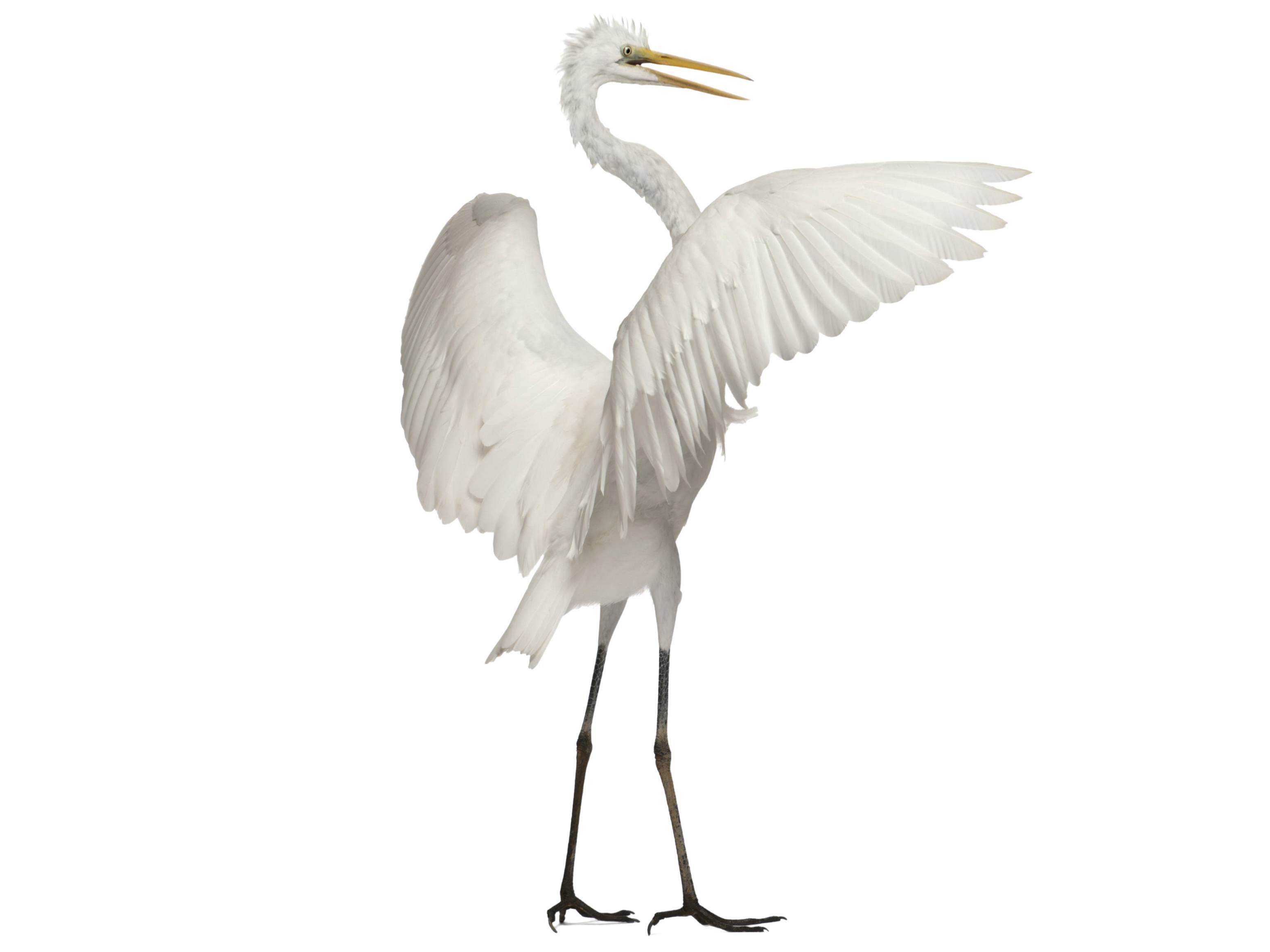
Great Egret
Ardea alba
The great egret, known scientifically as Ardea alba, is a majestic bird with a stately bearing and an impressive wingspan. This large egret is adorned with all-white plumage and can stand up to a meter tall. It is a cosmopolitan species, found across temperate and tropical regions worldwide.
Identification Tips
To identify the great egret, look for its yellow bill and contrasting black legs and feet, which may vary slightly during the breeding season. During this time, the bill may darken, and the lower legs may lighten. The great egret also sports ornamental feathers on its back when in breeding plumage. Both sexes appear identical, and juveniles resemble nonbreeding adults. The great egret can be distinguished from the intermediate egret by the gape of its bill, which extends well beyond the back of the eye.
Habitat
The great egret favors habitats close to water, such as large lakes with reed beds and other extensive wetlands. It nests in colonies, often at heights of 10 to 40 feet within trees.
Distribution
This bird has a vast range, occurring worldwide in suitable habitats. It is particularly common across the Sun Belt of the United States and throughout the Neotropics.
Behaviour
The great egret is known for its slow, graceful flight with its neck retracted, a characteristic of herons and bitterns. It walks with its neck extended and wings held close. Generally silent, it may emit a low, hoarse croak when disturbed and a louder croaking at breeding colonies.
Song & Calls
The great egret's vocalizations include a low croak when disturbed and various croaking and squawking sounds during the breeding season.
Breeding
Breeding begins at 2-3 years of age with monogamous pairings. The male initiates nest building to attract a female. The nest is a sizable structure of sticks, lined with plant material. The species lays up to six bluish-green eggs, with both parents sharing incubation duties over 23-26 days. The young are fed by regurgitation and can fly within 6-7 weeks.
Similar Species
The great egret can be confused with the snowy egret, which is smaller with a black bill and yellow feet. In North America, it may also be mistaken for the white morph of the great blue heron, which is larger with a thicker bill.
Diet and Feeding
The great egret's diet consists of fish, frogs, small mammals, reptiles, crustaceans, and insects. It typically forages in shallow water, standing still or slowly stalking its prey before impaling it with its sharp bill.
Conservation status
The great egret is listed as Least Concern by the IUCN. It has recovered from historical threats such as plume hunting and has adapted well to human presence. It is partially migratory, with some populations moving south during colder winters. The species is a symbol of conservation success and represents the National Audubon Society.






Great Egret Fun Facts
Great Egrets on Birda


Sightings


More Herons, Bitterns



Your birdwatching journey like never before

Connect with nature in minutes

Discover the joy of birding

Play your part in saving nature
Birda Blog


What Our Birders Say

Birding and wellbeing app
Gets me outdoors more
Easy to use and accurate
Very knowledgeable group
Simply fantastic
Great app
The best bird logging app
Best app for any birding person!
Very good database
Recommend for any bird watcher