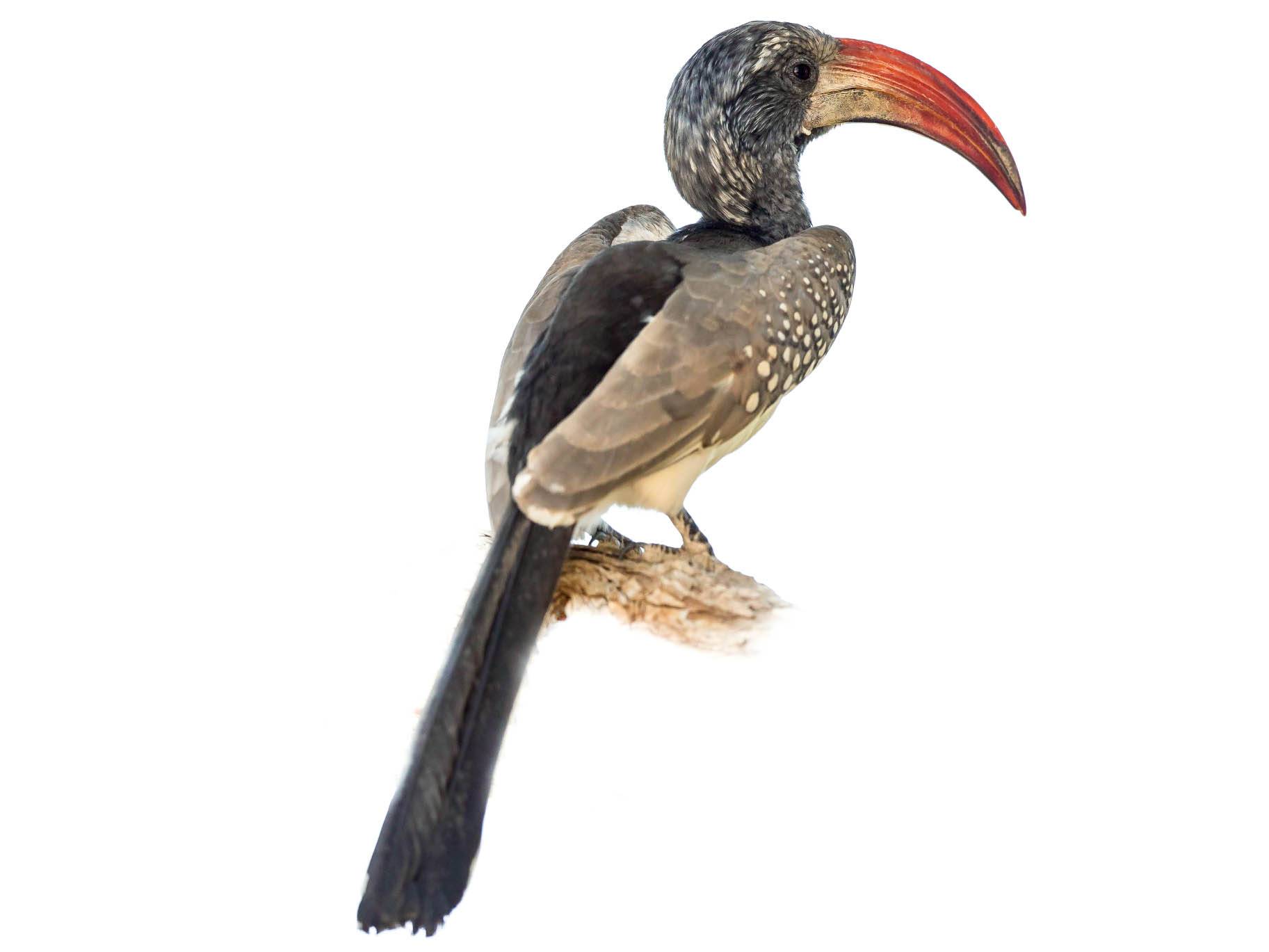
Monteiro's Hornbill
Tockus monteiri
The Monteiro's hornbill, known scientifically as Tockus monteiri, is a medium-sized bird, measuring 54–58 cm (21–23 in) in length. It is the largest hornbill within the Tockus genus, with a body mass ranging from 210 to 400 g (7.4 to 14.1 oz). This species boasts a striking plumage with a white belly and a black back. The wings are adorned with white spots, and the secondary flight feathers are also white. The long tail features white outer feathers. The male of the species can be distinguished by its size, being larger than the female, who is notable for her turquoise facial skin. Both sexes have black eyes and a vivid red beak.
Identification Tips
To identify the Monteiro's hornbill, look for the distinctive white belly contrasted against a black back, white-spotted wings, and white secondary flight feathers. The male's larger size and the female's turquoise facial skin are key differentiators. The red beak and black eyes are consistent across both sexes.
Habitat
The Monteiro's hornbill is native to the savannah and dry thornveldt of northwestern Namibia and southwestern Angola, where it thrives in arid environments.
Distribution
This hornbill is a common, near-endemic species in Namibia, with a total population estimated at 340,000 individuals. It is also found in southwestern Angola.
Behaviour
The Monteiro's hornbill exhibits unique feeding habits, as it exclusively consumes insects and other small arthropods. It is well-adapted to its arid habitat, and as such, does not require frequent drinking. During spring, these birds migrate to the southern Windhoek region for nesting. Breeding occurs at the end of a good rainy season, with the laying of 3 to 5 greyish-white eggs that hatch after about 45 days. Nests are typically constructed on rock faces or in trees.
Breeding
Monteiro's hornbills breed at the end of a favorable rainy season. They lay a clutch of 3 to 5 greyish-white eggs, which incubate for approximately 45 days before hatching. The nest is usually situated on rock faces or within the cavities of trees.
Diet and Feeding
The diet of the Monteiro's hornbill is exclusively insectivorous, feeding on a variety of insects and small arthropods.
Conservation status
The Monteiro's hornbill is currently classified as Least Concern on the IUCN Red List, indicating that it is not at immediate risk of population decline or habitat loss.






Monteiro's Hornbills on Birda


Sightings


More Hornbills



Your birdwatching journey like never before

Connect with nature in minutes

Discover the joy of birding

Play your part in saving nature
Birda Blog


What Our Birders Say

Work together with community
Love Birda
Clean and easy to use
Great app for learning Birds
Makes you want to spot birds more
Very encouraging birding app
Awesome App
Great App
Gets me outdoors more
A Friendly Place