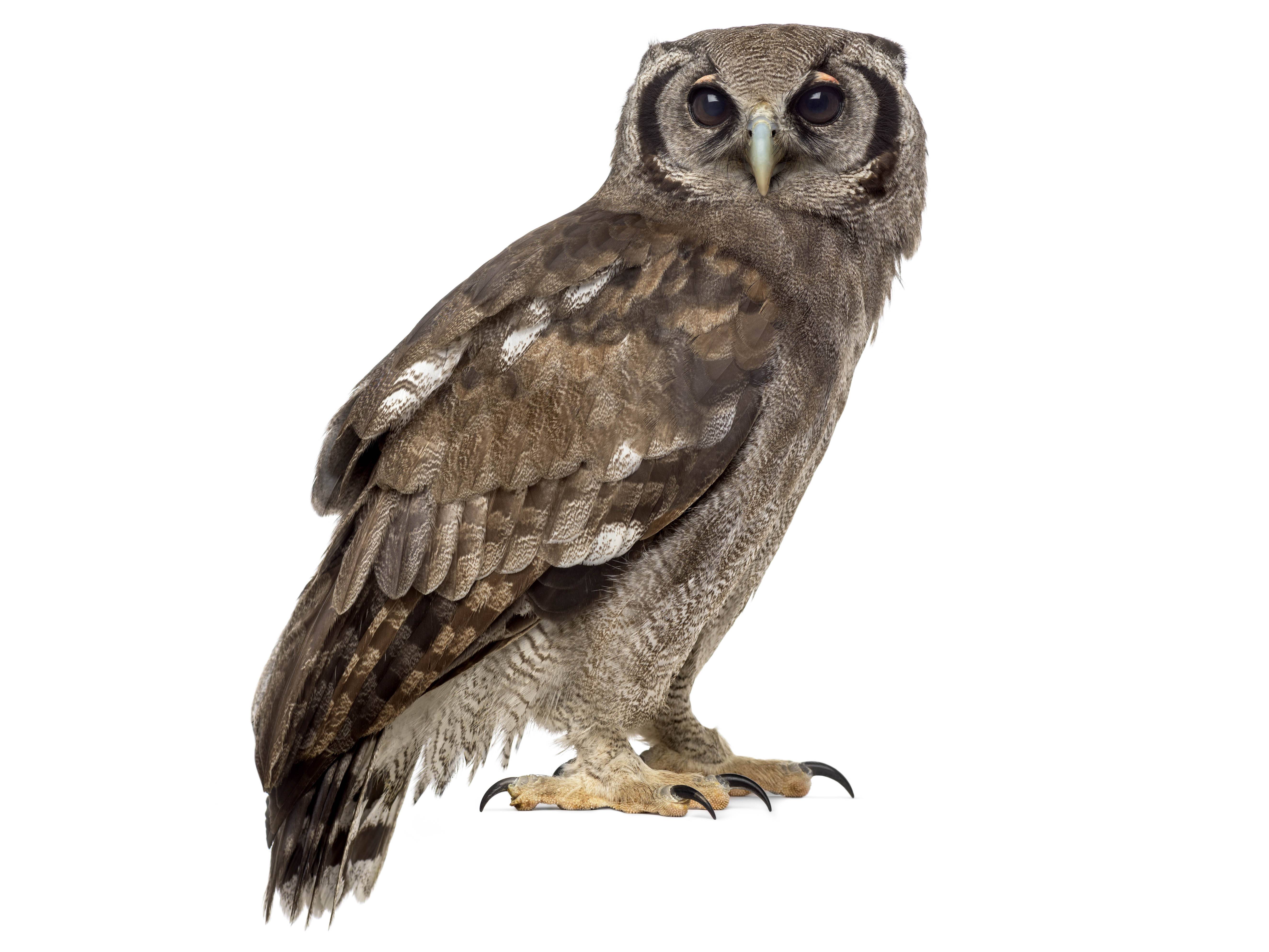
Verreaux's Eagle-Owl
Bubo lacteus
The Verreaux's eagle-owl (Ketupa lactea), also known as the milky eagle owl or giant eagle owl, is a formidable presence in the avian world. As the largest owl found in Africa and the most massive in the tropics, it commands attention with its impressive stature. This species can reach up to 66 cm (26 in) in total length, with females typically out-sizing males. Its plumage is primarily a soft grey, with fine brownish vermiculations on the underside and more solid light brown with white spots on the shoulder. The facial disc is paler, often whitish, with stark black borders. However, its most distinctive feature is the bright pink eyelids, unique among owl species.
Identification Tips
When observing Verreaux's eagle-owl, look for its large size, grey plumage, and the striking pink eyelids that are visible when the bird is at rest. The ear tufts are relatively small and may not be noticeable at a distance. The eyes are a deep brown, contrasting with the paler facial disc. In flight, its large wingspan is evident, which can reach nearly 164 cm (5 ft 5 in) in females.
Habitat
Verreaux's eagle-owl favors dry, wooded savanna environments, often bordering semi-arid regions. It can also be found in riverine forests adjacent to savannas and in small, semi-open woodlands. This species is adaptable to various elevations, from sea level to mountainous areas up to 3,000 m (9,800 ft), though it is generally scarce in rocky terrains.
Distribution
This eagle-owl is widespread across sub-Saharan Africa, with the highest densities in eastern and southern Africa. It is less common in the dense rainforests of west and central Africa, with a sporadic presence in transitional zones between the Sahara and rainforests.
Behaviour
Nocturnal by nature, Verreaux's eagle-owls spend their days roosting in trees, often on large horizontal branches. They are known to roost lightly, awakening quickly to defend themselves if necessary. Family groups, including offspring from previous years, may roost and preen together. Each pair defends a large territory, which can be up to 7,000 ha (17,000 acres) in size.
Song & Calls
The call of the Verreaux's eagle-owl is the deepest among owls, with the male's song resembling a series of deep "gwok" sounds. The female's call is similar but higher-pitched. Their vocalizations can carry for considerable distances, facilitating communication between mates and territorial defense.
Breeding
Verreaux's eagle-owls are monogamous and likely mate for life. They typically use large stick nests built by other birds, often on top of hamerkop nests or those constructed by large raptors. The female usually lays two white eggs, with the older chick often outcompeting the younger for food. Fledglings leave the nest before they can fly competently and remain dependent on their parents for several months.
Similar Species
The Shelley's eagle-owl (Ketupa shelleyi) is similar in size but has a darker, sooty coloration and prefers deep forests. The Cape eagle-owl (Bubo capensis) is smaller and has different plumage and eye color.
Diet and Feeding
Verreaux's eagle-owl is an opportunistic predator with a diet that includes mammals, birds, reptiles, amphibians, and insects. It is known to be the only routine predator of hedgehogs in Africa, skillfully removing their prickly skins before consumption.
Conservation Status
The IUCN lists Verreaux's eagle-owl as Least Concern due to its wide range and adaptability to habitat alterations. However, it occurs at low densities, and regional declines have been reported due to habitat destruction, persecution, and the effects of pesticides.






Verreaux's Eagle-Owls on Birda


Sightings


More Owls



Your birdwatching journey like never before

Connect with nature in minutes

Discover the joy of birding

Play your part in saving nature
Birda Blog


What Our Birders Say

Great app for bird lovers
Birding and wellbeing app
Work together with community
Fun way to add to your birdwatching experience
Fantastic app - Love it!
Friendly and helps to identify birds
Learning Birding with Birda
Makes you want to spot birds more
My favourite app
Clean and easy to use