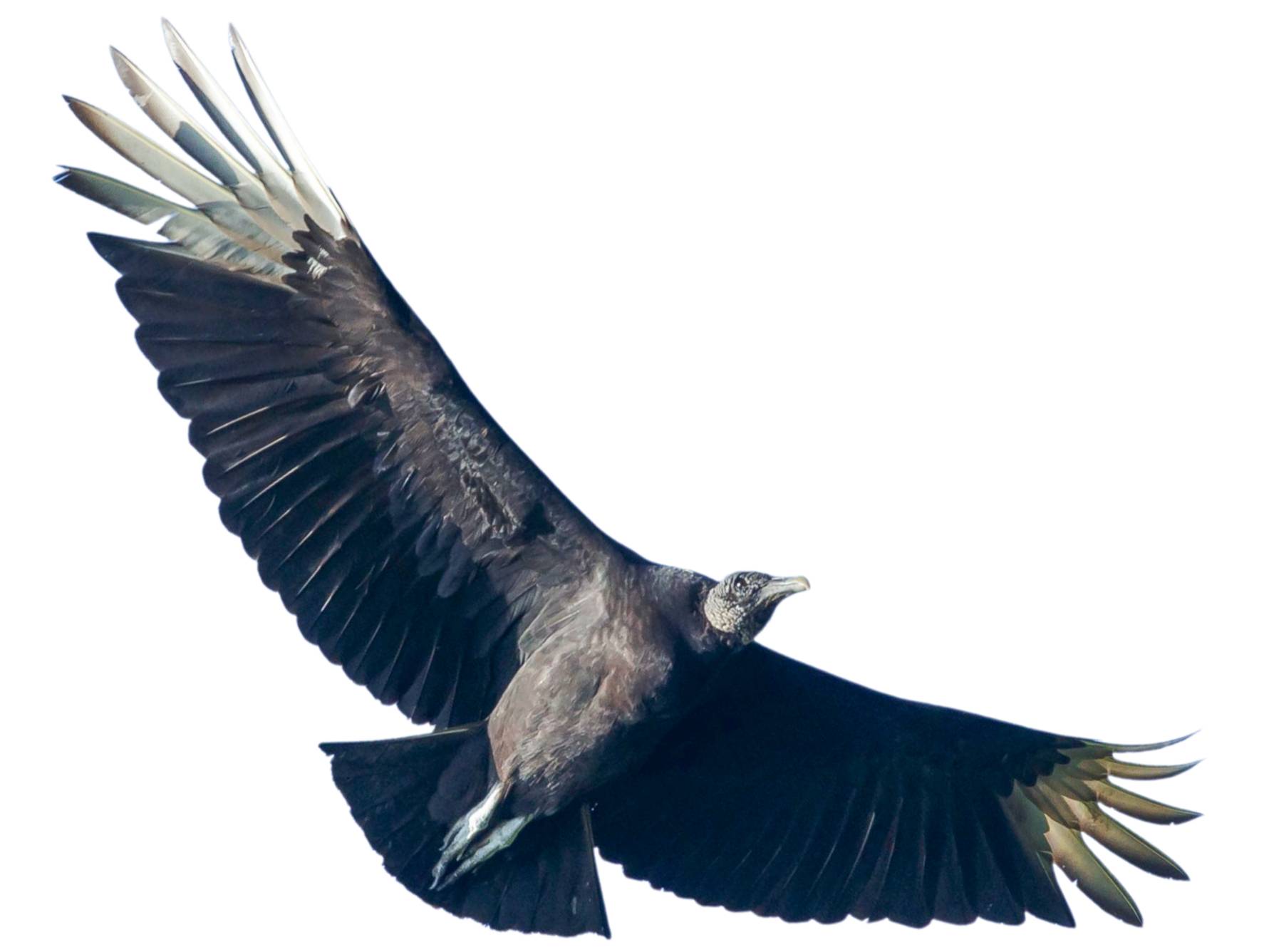
American Black Vulture
Coragyps atratus
The black vulture, known scientifically as Coragyps atratus, is a bird of considerable presence, with a wingspan stretching to approximately 1.5 meters (4.9 feet). This species, relatively small for a vulture, is cloaked in black plumage, with a featherless, grayish-black head and neck, and a short, hooked beak. These traits are evolutionary responses to its scavenging lifestyle.
Identification Tips
When identifying the black vulture, look for its glossy black feathers and dark gray, wrinkled skin on the head and neck. The bird's eyes are brown, and its legs are a contrasting grayish white. In flight, the white patches at the base of the primary feathers are visible against the black of its wings. The tail is short and square, not extending past the folded wings.
Habitat
Black vultures favor open areas with scattered trees, such as chaparral, as well as subtropical forests and parts of the Brazilian pantanal. They are also found in moist lowland forests, shrublands, grasslands, wetlands, swamps, pastures, and degraded former forests.
Distribution
The range of the black vulture extends from the southeastern United States down to Peru, Central Chile, and Uruguay in South America. It is generally a permanent resident throughout its range, with some local movements in response to environmental conditions.
Behaviour
In flight, the black vulture is less efficient than other vultures due to its shorter wings. It soars high, flapping in short bursts followed by gliding. On the ground, it may regurgitate when disturbed and is known to defecate on its legs to cool itself through evaporation—a process called urohidrosis. The black vulture is gregarious, roosting and foraging in groups, and can be aggressive when feeding.
Song & Calls
Lacking a syrinx, the black vulture's vocalizations are limited to grunts or low hisses, particularly when agitated or feeding.
Breeding
Black vultures breed at various times depending on their geographic location. Courtship involves ground displays and possibly flight. They lay their eggs on the ground or in cavities, with clutches typically consisting of two eggs. Both parents incubate and regurgitate food for the young, who fledge after about 75 to 80 days.
Similar Species
The black vulture can be confused with the turkey vulture, but the latter has a red head and is generally solitary when foraging, whereas the black vulture is more social.
Diet and Feeding
Primarily scavengers, black vultures feed on carrion but will also consume eggs, small reptiles, and newborn animals. They locate food using keen eyesight or by following other vultures with a strong sense of smell. They play a crucial role in the ecosystem by disposing of dead animals.
Conservation status
The black vulture is classified as Least Concern by the IUCN Red List, with stable populations and no significant decline to warrant a threatened status. It is protected under various migratory bird treaties in the Americas.






American Black Vulture Fun Facts
American Black Vultures on Birda


Sightings



Your birdwatching journey like never before
Connect with nature in minutes

Discover the joy of birding

Play your part in saving nature
Birda Blog


What Our Birders Say

Fantastic App
Simply fantastic
Really great app
Easy to use and accurate
Makes you want to spot birds more
Awesome App
Very encouraging birding app
Great app for bird lovers
App got me interested in birding!
Friendly and helps to identify birds