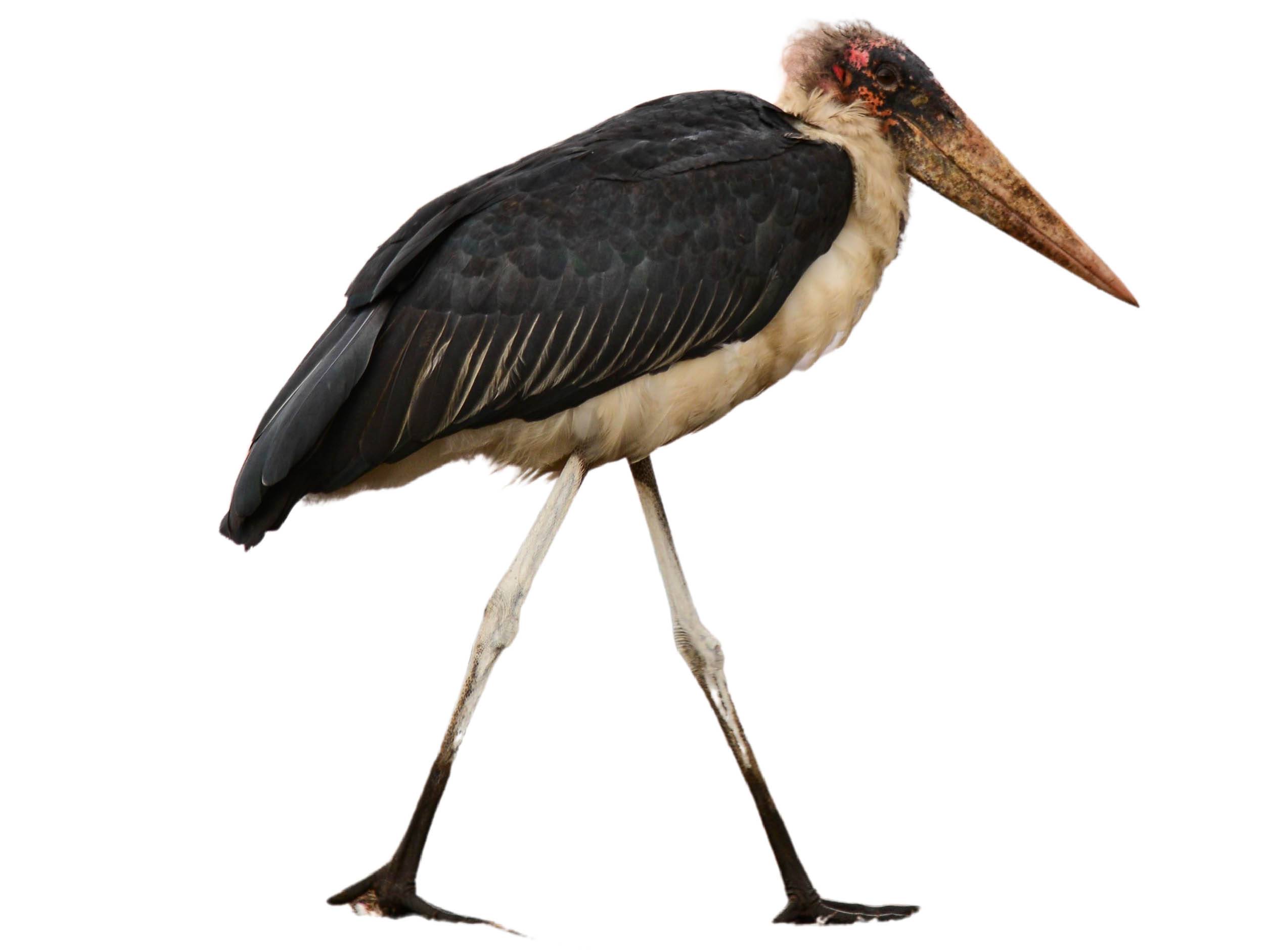
Marabou
Leptoptilos crumenifer
The Marabou Stork, Leptoptilos crumenifer, is a formidable presence in the avian world, with its massive stature and striking appearance. It stands tall at approximately 152 centimeters and can weigh up to 9 kilograms. Its wingspan is a sight to behold, stretching up to 3.7 meters, rivaling even the Andean condor in breadth. The marabou is adorned with a black back, contrasting white underparts, and a distinctive bare head and neck. Its bill is robust, and it sports a pink gular sac at its throat, a neck ruff, and white legs. Both sexes appear similar, though the female is typically smaller, and juveniles are browner with a less pronounced bill.
Identification Tips
To identify the Marabou Stork, look for its large size, bare head, and neck, along with its black back and white underparts. The bird's enormous bill and pink throat sac are also key characteristics. When in flight, note that unlike most storks, the Marabou Stork flies with its neck retracted, resembling a heron.
Habitat
The Marabou Stork is native to sub-Saharan Africa, where it can be found in a variety of habitats, both wet and arid. It often resides near human habitation, particularly around landfill sites.
Distribution
This species is widespread across sub-Saharan Africa, from Senegal to Ethiopia, and down to South Africa. It is a common sight in both urban and less populated areas, depending on the region.
Behaviour
The Marabou Stork is known for its gregarious nature, often seen in groups. It is a colonial breeder, particularly during the dry season when food is more abundant. The bird has a reputation for being ill-tempered and is not particularly vocal, though it engages in bill-rattling courtship displays. The throat sac plays a role in producing sounds during this time.
Song & Calls
The Marabou Stork is relatively quiet compared to other birds, but it does engage in bill-rattling as part of its courtship ritual.
Breeding
Breeding occurs in colonies during the dry season. The female lays two to three eggs in a stick nest, with the eggs hatching after 30 days. Young Marabou Storks reach sexual maturity at 4 years, and the species can live up to 43 years in captivity and 25 years in the wild.
Diet and Feeding
The Marabou Stork is an opportunistic feeder, primarily scavenging on carrion, scraps, and faeces. It is known to consume a wide range of animal matter, including fish, frogs, insects, small mammals, and reptiles. During the breeding season, it focuses on small, live prey to feed its nestlings. The bird often follows vultures to feed on carcasses and may become dependent on human garbage, consuming almost anything it can swallow.
Conservation status
The Marabou Stork is currently listed as Least Concern on the IUCN Red List, indicating that it is not at immediate risk of population decline.
Similar Species
The Marabou Stork can be confused with other large storks, such as the adjutants (Leptoptilos spp.), but can be distinguished by its unique bare head, neck, and pink throat sac.
Threats
Adult Marabou Storks face few natural predators and enjoy a high annual survival rate. However, they can fall prey to ambush by lions. They are also susceptible to various endoparasites, which can impact their health and longevity.






Marabous on Birda


Sightings



Your birdwatching journey like never before

Connect with nature in minutes

Discover the joy of birding

Play your part in saving nature
Birda Blog


What Our Birders Say

Gets me outdoors more
Awesome App
Great App
A great app
Great app
Friendly and helps to identify birds
Great app for bird fanatics
Very knowledgeable group
Really great app
Makes you want to spot birds more