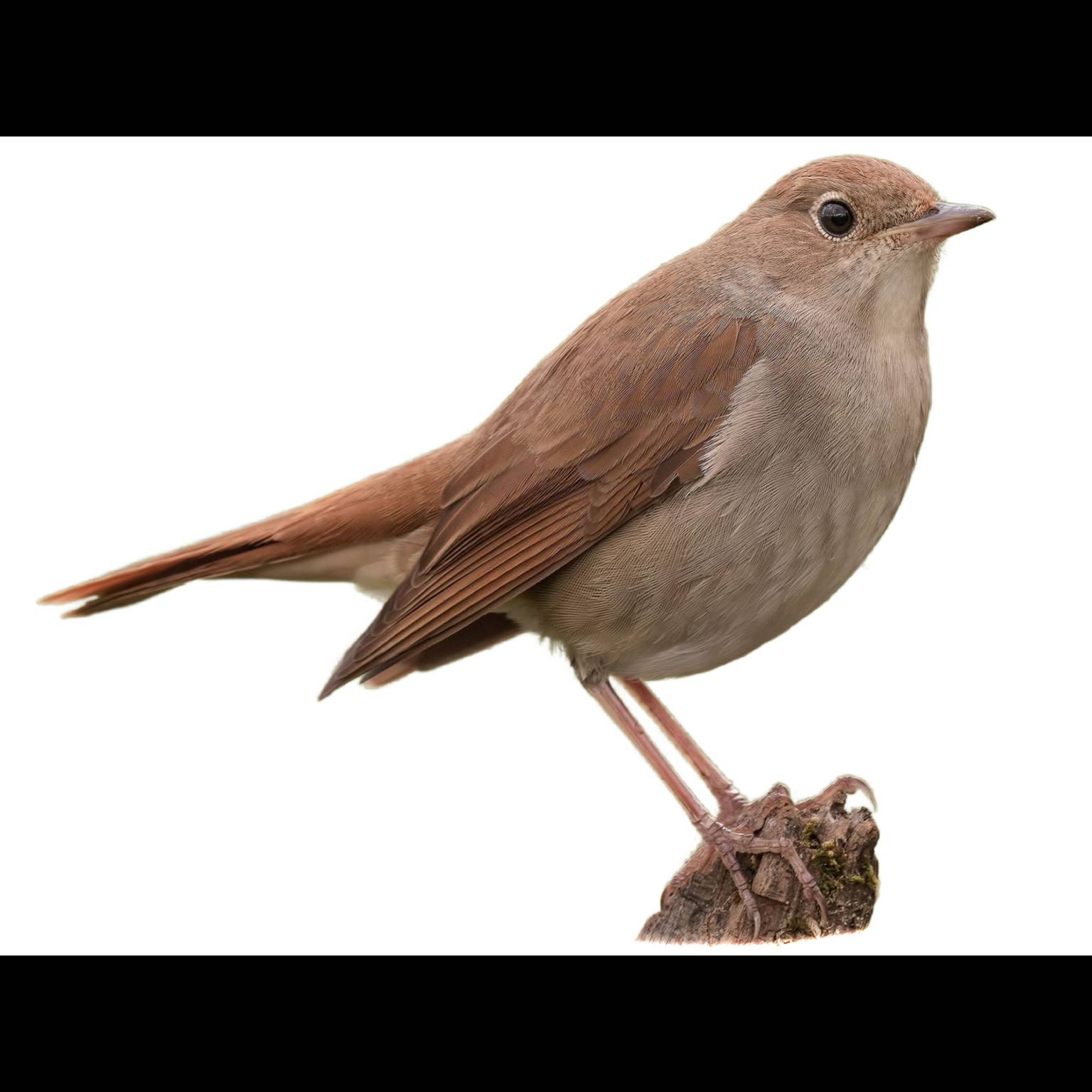
Common Nightingale
Luscinia megarhynchos
The Common Nightingale, also known as the Rufous Nightingale or simply Nightingale (Luscinia megarhynchos), is a small passerine bird celebrated for its powerful and enchanting song. This bird, once thought to be a member of the thrush family, is now classified among the Old World flycatchers, Muscicapidae. It is part of a group often referred to as chats, which are more terrestrial in nature.
Identification Tips
The Common Nightingale is slightly larger than the European Robin, measuring approximately 15–16.5 cm in length. It has a plain brown upper body contrasted by a reddish tail, while its underparts range from buff to white. Both sexes appear similar, with the eastern and Caucasian subspecies displaying paler upper parts and a more pronounced facial pattern, including a pale supercilium.
Habitat
Nightingales favor breeding in forests and scrublands within the Palearctic region. They nest on or near the ground amidst dense vegetation, avoiding areas with closed canopies.
Distribution
As migratory birds, nightingales breed across Europe and parts of the Palearctic, journeying to Sub-Saharan Africa to overwinter. Their distribution is more southerly compared to their close relative, the Thrush Nightingale.
Behaviour
The male Common Nightingale is renowned for its nocturnal singing, which is thought to attract a mate. Unpaired males are the most frequent nighttime vocalists. The bird's song is also a territorial anthem, particularly at dawn. In urban areas, nightingales sing more loudly to overcome background noise.
Song & Calls
The male's song is a complex symphony of whistles, trills, and gurgles, noted for its loud, whistling crescendo. The nightingale also emits a frog-like alarm call when disturbed.
Breeding
The Common Nightingale's breeding preferences are influenced by geographical factors such as altitude, temperature, precipitation, and aridity. They are ground nesters, often choosing sites with ample cover.
Similar Species
The Thrush Nightingale (Luscinia luscinia) is very closely related but can be distinguished by the absence of the loud whistling crescendo in its song.
Diet and Feeding
As insectivorous birds, nightingales feed on a variety of insects and their larvae, which they forage for on the ground.
Conservation Status
The Common Nightingale is classified as Least Concern by the IUCN. However, in the UK, the species is on the red list for conservation due to a contracting range and declining numbers. Conversely, the European population is estimated to be between 3.2 and 7 million pairs, indicating a stable status.






Common Nightingale Fun Facts
Common Nightingales on Birda


Sightings



Your birdwatching journey like never before

Connect with nature in minutes

Discover the joy of birding

Play your part in saving nature
Birda Blog


What Our Birders Say

Gets me outdoors more
Loving it
Fantastic
Great app for learning Birds
Awesome App
My favourite app
I really like Birda
Sense of Community
Very Wholesome App
Birding and wellbeing app