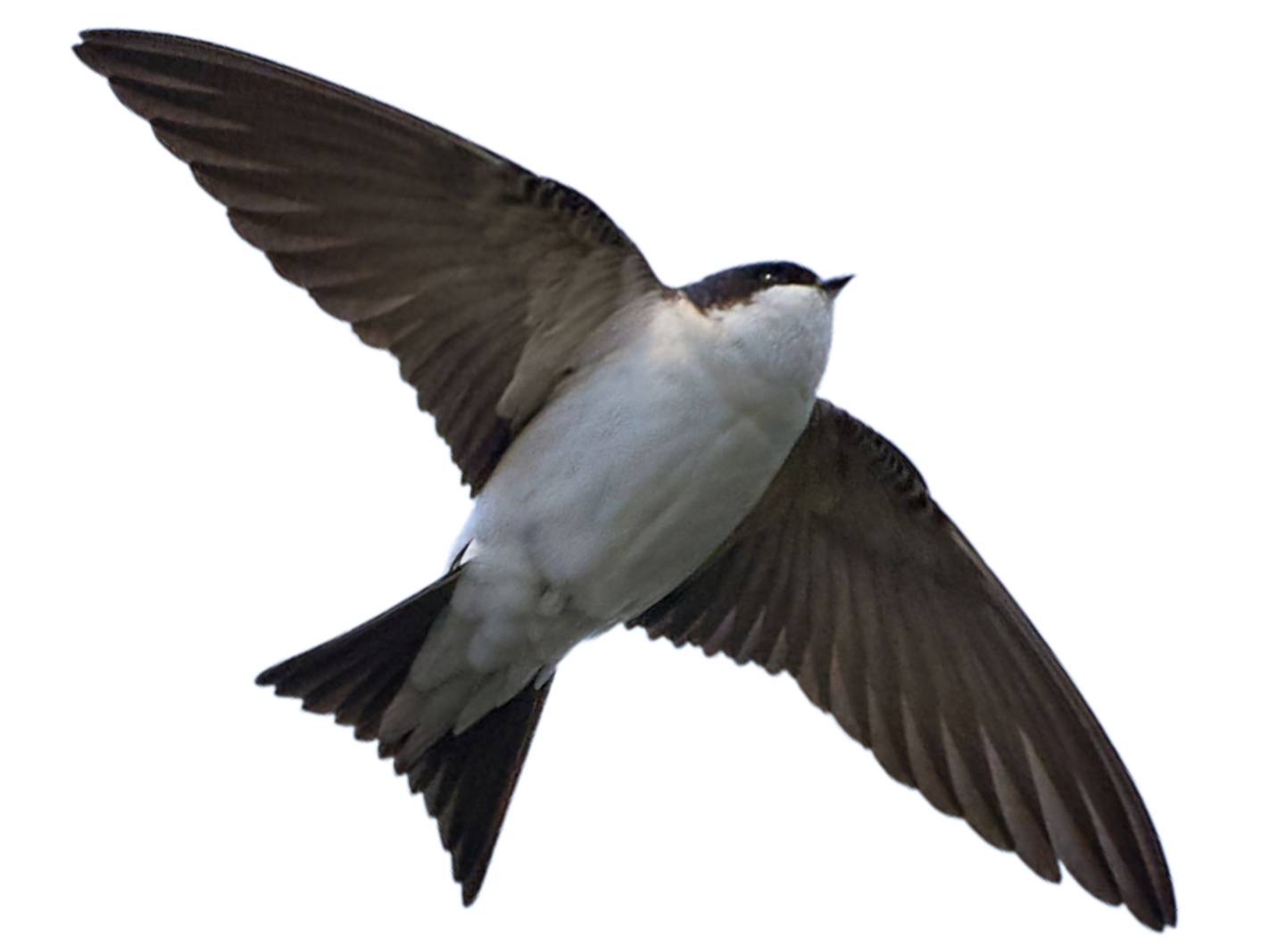
Common House-Martin
Delichon urbicum
The Western House Martin (Delichon urbicum), sometimes known as the Common House Martin, is a migratory passerine bird belonging to the swallow family. It is characterized by a blue head and upperparts, a distinctive white rump, and pure white underparts. This species exhibits sexual dimorphism, with both sexes appearing similar, and juveniles displaying a sooty black coloration with white-tipped wing coverts and quills.
Identification Tips
Adults measure approximately 13 cm in length, with a wingspan ranging from 26 to 29 cm and an average weight of 18.3 grams. They possess brown eyes, a small black bill, and pink toes and exposed leg parts. The white rump and underparts are particularly noticeable in flight, aiding in distinguishing them from other swallows.
Habitat
The Western House Martin favors open country with low vegetation, such as pastures, meadows, and farmland, often near water. It is also found in urban areas and can nest in city centers if air quality permits.
Distribution
This bird breeds across Europe, North Africa, and the Palearctic, migrating to sub-Saharan Africa and tropical Asia for the winter. It is a broad-front migrant, traveling during daylight and feeding on insects in flight.
Behaviour
The Western House Martin is a social bird, often breeding colonially with nests built in close proximity. It is known for its aerial agility, which it uses to evade predators such as the Eurasian Hobby.
Song & Calls
The male's song is a soft twitter of melodious chirps, while the contact call is a hard "chirrrp." The alarm call is a shrill "tseep."
Breeding
Nests are constructed from mud pellets under eaves or similar overhangs on buildings, usually in colonies. The species is known to produce two broods per year, with four to five white eggs per brood. Juveniles fledge after 22 to 32 days and are fed by parents for about a week thereafter.
Similar Species
The Western House Martin can be confused with the Asian House Martin (D. dasypus) and the Nepal House Martin (D. nipalense), but it is the only one with a pure white rump and underparts.
Diet and Feeding
The diet consists primarily of insects caught in flight, with a preference for flies and aphids. Hunting typically occurs within 450 meters of the nest and often near open ground or water.
Conservation status
The Western House Martin is classified as Least Concern by the IUCN, with an extensive range and large population. However, there are indications of population fluctuations and declines in certain regions, attributed to factors such as weather, pesticides, and competition for nesting sites.






Common House-Martins on Birda


Sightings



Your birdwatching journey like never before

Connect with nature in minutes

Discover the joy of birding

Play your part in saving nature
Birda Blog


What Our Birders Say

Great app for beginner twitchers
Loving it
My favourite app
Makes you want to spot birds more
Fantastic to be involved
Fun way to add to your birdwatching experience
Great app for bird fanatics
Gets me outdoors more
Best app for any birding person!
Learning Birding with Birda