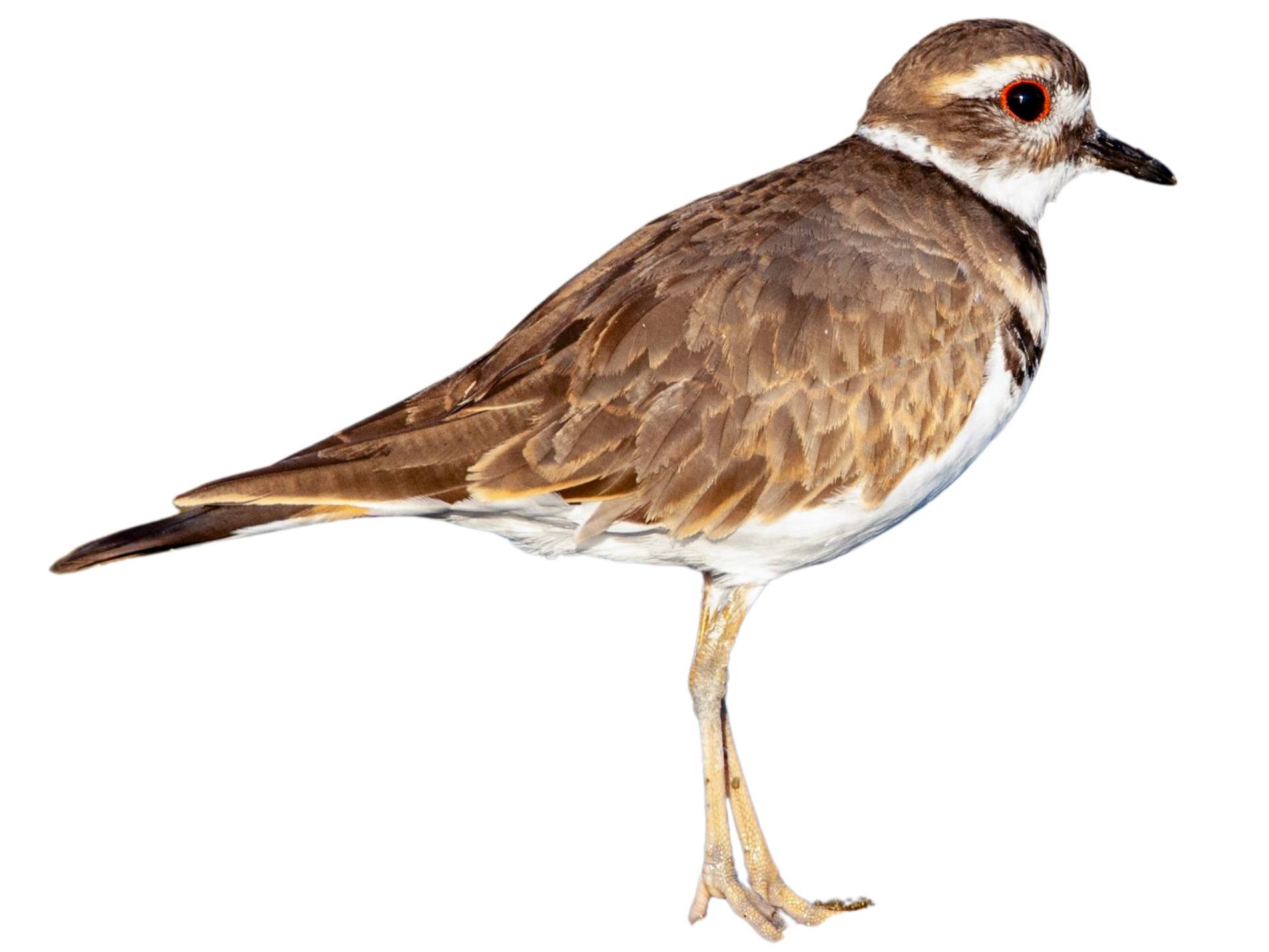
Killdeer
Charadrius vociferus
The Killdeer, Charadrius vociferus, is a sizable member of the plover family, easily recognized by its distinctive plumage and vocalizations. Adults range from 20 to 28 cm in length, with a wingspan of 59 to 63 cm, and weigh between 72 and 121 grams. They exhibit a short, thick, dark bill, flesh-colored legs, and a red eye ring. The upperparts are predominantly brown with rufous fringes, while the head is adorned with white and black patches. Notably, two black bands cross the breast, a unique feature among North American plovers.
Identification Tips
When observing a Killdeer, look for the two distinct black bands on the breast, which set it apart from other plovers. The rump is a vivid red, and the tail is primarily brown with a black subterminal band and white terminal band. In flight, a white wing stripe is visible. The female may have slightly browner markings than the male.
Habitat
The Killdeer is versatile in its choice of habitat. While it is a shorebird, it does not strictly nest near water. Its breeding grounds are typically open fields with short vegetation, but it has been known to adapt to human environments, such as rooftops.
Distribution
The Killdeer's range is extensive, spanning from southeastern Alaska and southern Canada through to Mexico. It is a year-round resident in the southern half of its breeding range, with some populations migrating to Central America, the West Indies, and northern South America for the winter.
Behaviour
The Killdeer is known for its elaborate breeding displays, including loud calls and the "broken-wing" act to distract predators from its nest. It is a territorial bird, with both sexes participating in nest defense. The young are precocial and leave the nest shortly after hatching, guided by their parents to a safe feeding territory.
Song & Calls
This bird is named for its piercing "kill-deer" call. It is vocal both day and night, with a repertoire that includes nasal notes and rapid trills when alarmed.
Breeding
Killdeer pairs form upon arrival at breeding grounds. The nest is a simple ground scrape, often lined with white materials like pebbles or shell fragments. Egg-laying occurs from mid-March to August, with clutches of four to six buff to beige eggs. Both parents incubate the eggs for 22 to 28 days, and the young fledge about 31 days after hatching.
Similar Species
The Killdeer is distinguished from similar species by its double breast bands and red rump. It is the only North American plover with this combination of features.
Diet and Feeding
The diet consists mainly of insects, with the addition of other invertebrates and seeds. The Killdeer forages in fields, often near cattle, which help maintain short vegetation. It uses visual cues to locate prey and may forage at night during the full moon due to increased insect activity and reduced predation risk.
Conservation status
The Killdeer is classified as Least Concern by the IUCN. Despite a declining population, it is not considered vulnerable due to its large range and overall population numbers. It is protected under the American Migratory Bird Treaty Act and the Canadian Migratory Birds Convention Act.






Killdeer on Birda


Sightings



Your birdwatching journey like never before

Connect with nature in minutes

Discover the joy of birding

Play your part in saving nature
Birda Blog


What Our Birders Say

Great app for learning Birds
Gets me outdoors more
Fantastic App
Sense of Community
Wonderful App
Best app for any birding person!
Just what birding needs
Easy to use and accurate
Makes you want to spot birds more
A great app