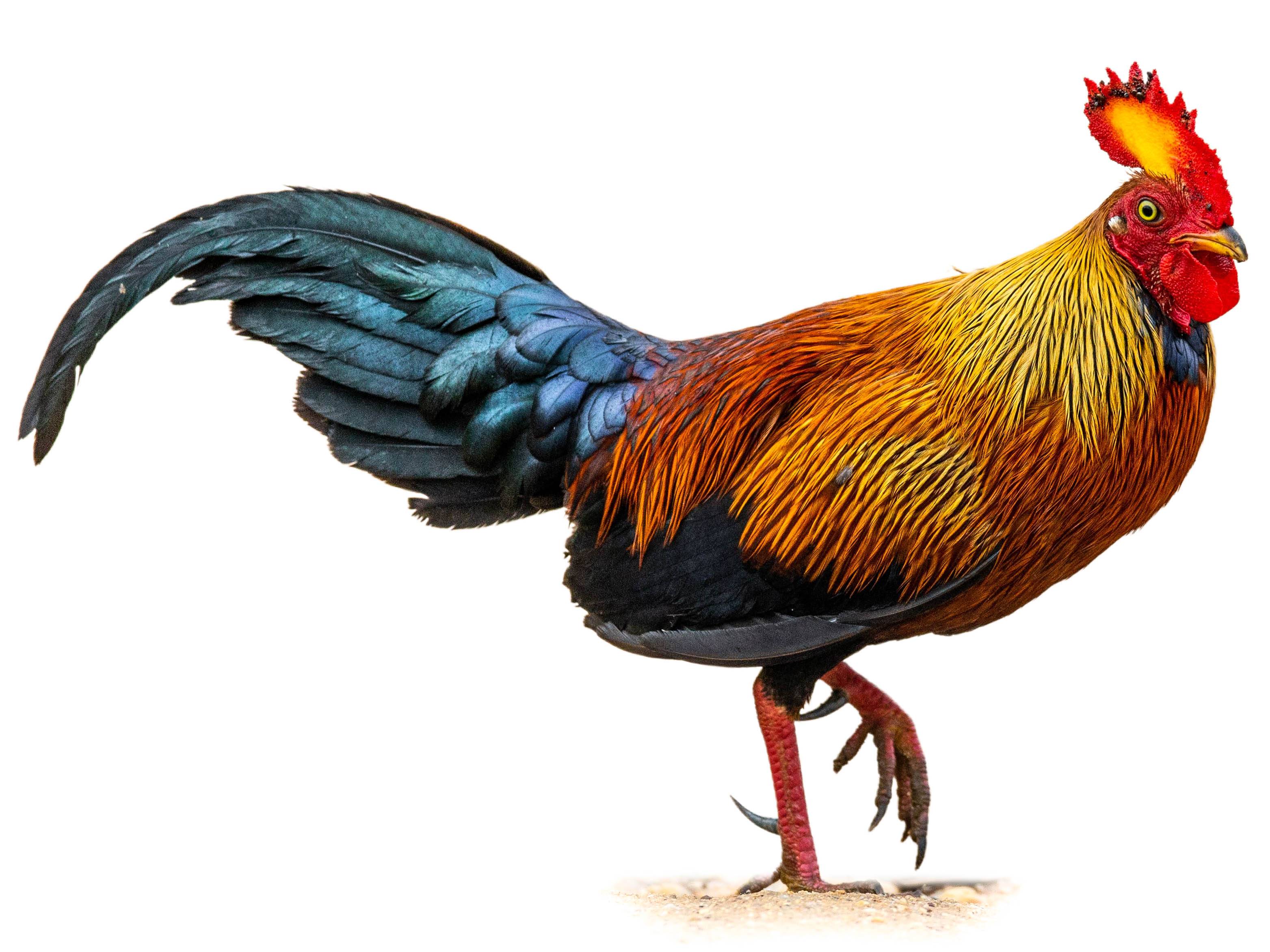
Sri Lanka Junglefowl
Gallus lafayettii
The Sri Lankan junglefowl, also known as the Ceylon junglefowl or Lafayette's junglefowl, is a vibrant and sexually dimorphic bird, endemic to the lush landscapes of Sri Lanka. The male, with its striking orange-red body plumage and dark purple to black wings and tail, resembles a large, muscular rooster. Golden feathers cascade from its head down to the base of its spine, while its face boasts bare red skin and wattles, topped with a red comb featuring a yellow center. The female, in contrast, is considerably smaller and cloaked in dull brown plumage with white patterns on her underbelly, a masterful camouflage for a nesting bird.
Identification Tips
To identify the male Sri Lankan junglefowl, look for a bird with a body length of 66–72 cm and a weight of 790–1,140 g. The male's plumage is predominantly orange-red with darker wings and tail, and a distinctive golden mane. The female is notably smaller, measuring only 35 cm in length and weighing 510–645 g, with her brown and white patterned plumage providing excellent camouflage.
Habitat
This species thrives in forests and scrub habitats across Sri Lanka, from the lowlands to elevations of up to 2000 meters. It is a common sight in locations such as Kitulgala, Yala, and the Sinharaja Forest Reserve.
Distribution
The Sri Lankan junglefowl is found exclusively in Sri Lanka, where it enjoys the status of national bird.
Behaviour
Primarily terrestrial, these birds spend much of their time foraging on the ground, scratching for seeds, fallen fruit, and insects. They exhibit complex anti-predator behaviors and foraging strategies that have evolved over time.
Song & Calls
The male Sri Lankan junglefowl communicates with short calls of "kreeu, kreeu, kreeuu" while foraging and emits a high-pitched, rooster-like crow "cor-cor-chow" at dawn, often from a tree branch. The female makes a "kwikkuk, kwikkukkuk" sound. During the breeding season, the male becomes more vocal with various calls used in mating displays, territorial defense, and interactions with rivals.
Breeding
The Sri Lankan junglefowl engages in facultative polyandry, where a single female typically mates with two or three males, often siblings, forming a pride. The alpha male assists with nest protection and chick rearing. The female's eggs vary in color, usually cream with a yellow or pink tint and often spotted with purple or brown. Incubation is relatively short, possibly as brief as 20 days.
Similar Species
The Sri Lankan junglefowl is closely related to the grey junglefowl and shares similarities with the female grey junglefowl. However, the male more closely resembles the red junglefowl in appearance.
Diet and Feeding
The diet of the Sri Lankan junglefowl consists mainly of insects and isopods, with juvenile land crabs playing a crucial role in the growth and survival of the young. They require a diet rich in live food and are not well-suited to commercial poultry feed.
Conservation status
The Sri Lankan junglefowl is currently listed as Least Concern on the IUCN Red List, indicating a stable population without significant threats to its survival.






Sri Lanka Junglefowl Fun Facts
Sri Lanka Junglefowls on Birda


Sightings



Your birdwatching journey like never before

Connect with nature in minutes

Discover the joy of birding

Play your part in saving nature
Birda Blog


What Our Birders Say

A Friendly Place
Birda fan
Great app for bird fanatics
Love Birda
Fantastic
Great app for learning Birds
My favourite app
Simply fantastic
Very knowledgeable group
Very good database