Common Rock Thrush
Monticola saxatilis
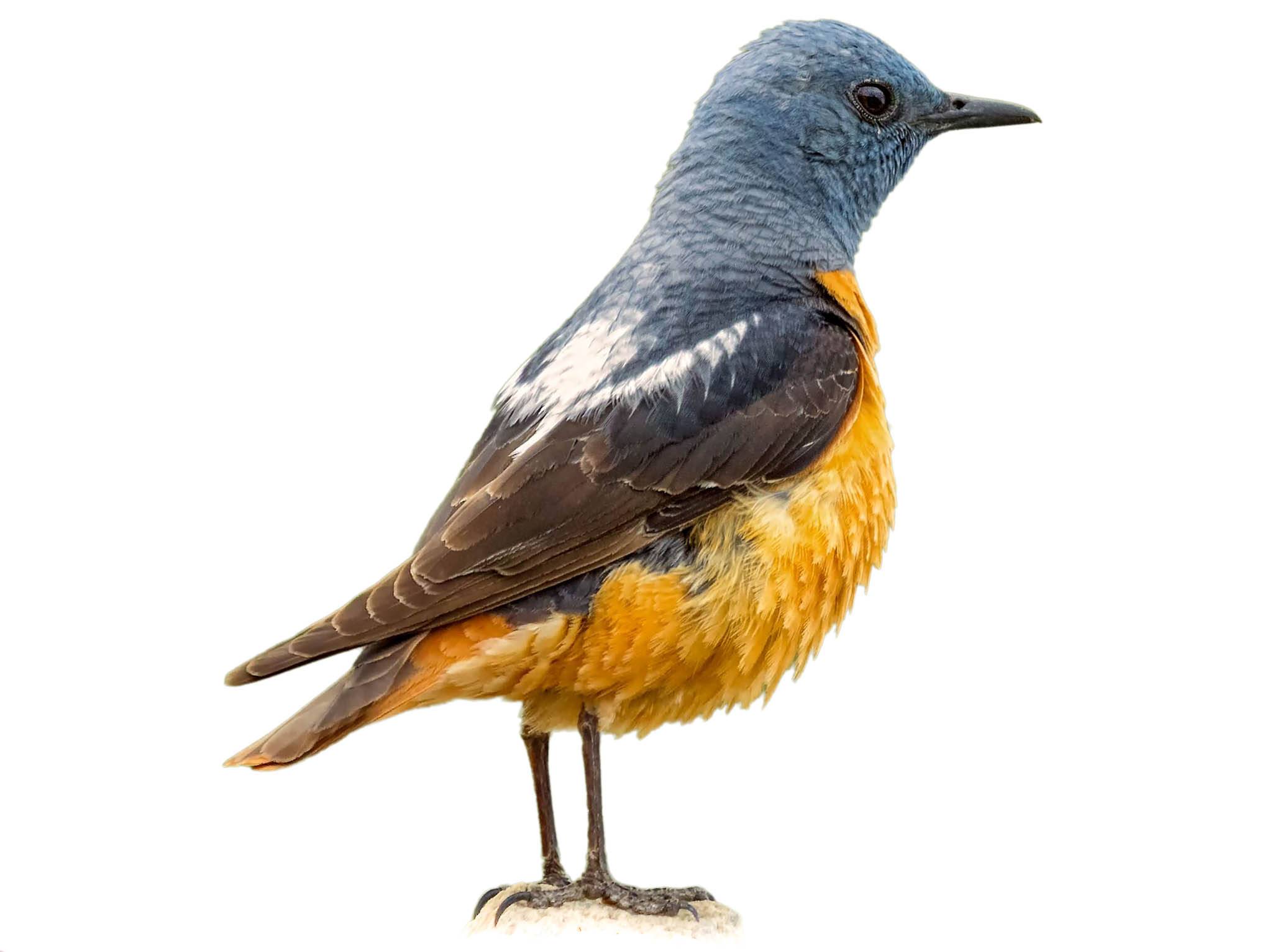
The Common Rock Thrush, scientifically known as Monticola saxatilis, is a medium-sized, stocky member of the chat family, Muscicapidae. It exhibits a striking plumage, particularly in the male during the summer months, with a blue-grey head, vibrant orange underparts, and outer tail feathers, contrasting dark brown wings, and a white back. Females and immature birds are less conspicuous, displaying dark brown, scaly upperparts and paler brown, scaly underparts, with the outer tail feathers retaining a reddish hue reminiscent of the male.
Identification Tips
To identify the Common Rock Thrush, look for the male's distinctive blue-grey head and orange underparts during the breeding season. Outside of this period, both sexes can be recognized by their scaly brown plumage and the reddish tinge on their outer tail feathers. They measure between 17 to 20 cm in length, making them a relatively easy spot in their natural habitat.
Habitat
This species favors open, dry, and hilly terrains, typically establishing itself at altitudes above 1500 meters. It is here, amidst the rocky outcrops and sparse vegetation, that the Common Rock Thrush thrives.
Distribution
The Common Rock Thrush breeds across a wide range, from southern Europe to Central Asia and extending to northern China. It is a strongly migratory bird, with all populations wintering in Africa, south of the Sahara. While it is an uncommon visitor to northern Europe, its range has seen some contraction due to habitat destruction.
Behaviour
The Common Rock Thrush is known for its breeding behavior, which includes nesting in rock cavities and laying 4 to 5 eggs. It is an omnivorous bird, feeding on a varied diet that includes insects, berries, and small reptiles. The male is noted for its clear and melodious song, which adds to the bird's charm.
Song & Calls
The male Common Rock Thrush's song is particularly tuneful, a delightful melody that resonates across its mountainous habitat.
Breeding
During the breeding season, the Common Rock Thrush nests in cavities found within rocky landscapes. A typical clutch consists of 4 to 5 eggs.
Diet and Feeding
An omnivorous bird, the Common Rock Thrush partakes in a diet that encompasses a wide range of insects, various berries, and even small reptiles, showcasing its adaptability in foraging.
Conservation status
The IUCN Red List currently categorizes the Common Rock Thrush as Least Concern, indicating that, despite some habitat loss at the periphery of its range, it is not considered globally endangered at this time.






Common Rock Thrushes on Birda


Sightings


More Chats, Old World Flycatchers



Your birdwatching journey like never before

Connect with nature in minutes

Discover the joy of birding

Play your part in saving nature
Birda Blog


What Our Birders Say

Makes you want to spot birds more
Birda fan
Love Birda
Such a great app!
Loving it
Gets me outdoors more
Terrific App for Birders
A Friendly Place
Really useful
Great app for bird lovers